This must one of the most studied, rebuilt, cloned, copied circuits ever.
The Big Muff Pi (π), often known simply as the Big Muff, is a fuzzbox produced in New York City by Electroharmonix (and their Russian subsidiary , Sovtek). These are mainly guitar pedals.
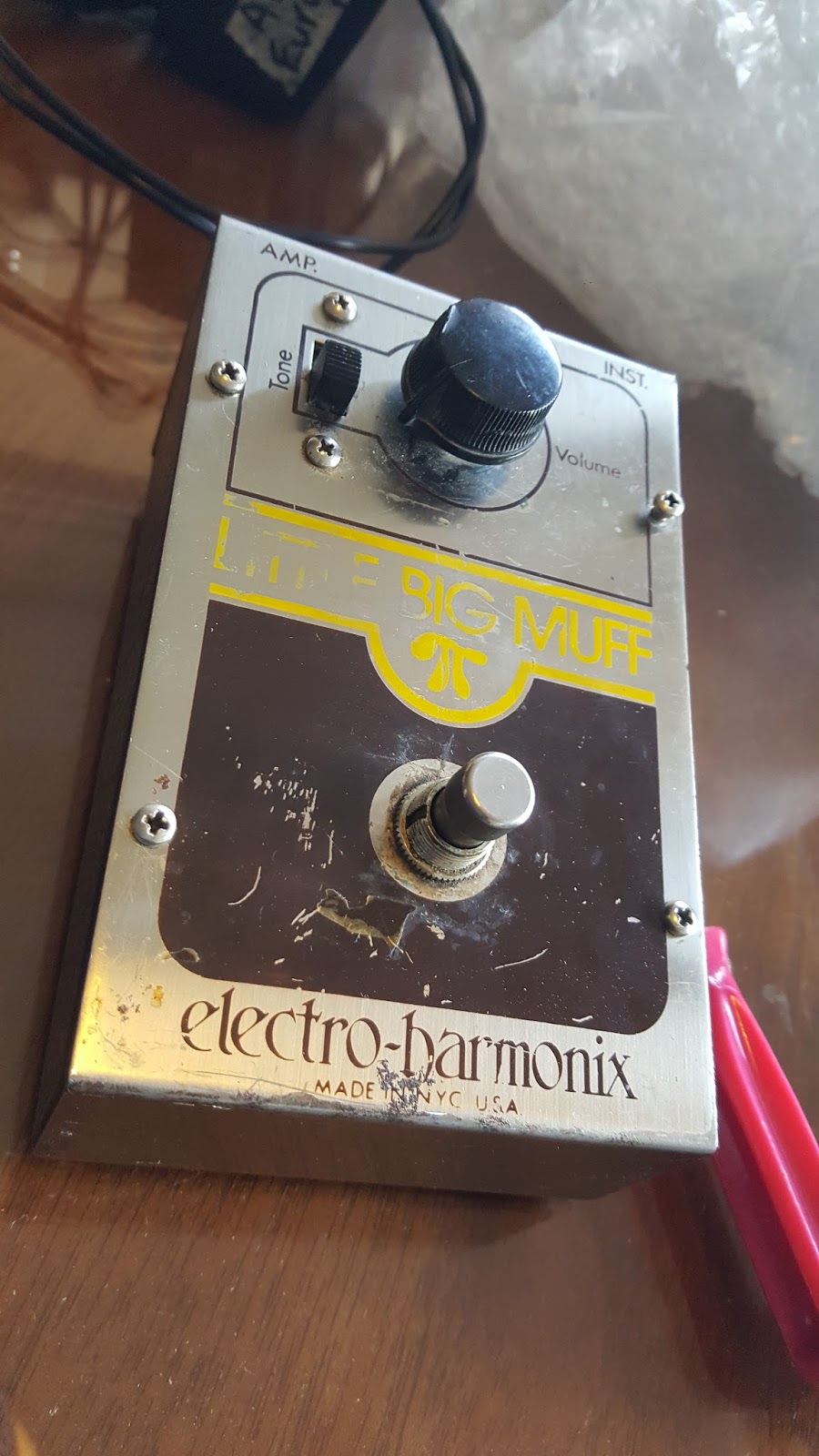
The famous Mike Matthews Electro-Harmonix Big Muff guitar pedal. Pink Floyd used it. So did the Smashing Pumpkins. Jimmy Hedndrix gave it immortality. The list of artists is endless.
There are countless variations too. You can buy kits on the net with PCB & parts supplied to save you the hassle of understanding the circuit. But I like to know how things work. I'll build this on perf board.
So here is the basic circuit.
So how does it work?
The signal comes in through R2 and
C1 before hitting the first stage, a basic transistor
signal booster (Q4). Once the signal is
boosted, it goes through C4 and enters R24 (the sustain potentiometer). This controls the gain.
The signal goes through C5
and R19 before hitting the next stage, which is
doing 2 things. Boosting and clipping the signal. The clipping is achieved via the diodes (D1 and D2) & C6/C12.
The signal then goes through
C13 and R12 before hitting the next stage : tone
control.
It's identical to the previous diode clipping stage apart from the tone pot (R25) which pans between a high-pass and a low-pass. This explains
why when you turn the tone control down the
sound is very bassy, while turning it up cuts
the bass, and it gets very bright.
After leaving
the tone pot, the signal goes through C3
and enters into the final signal boosting stage
before exiting through C2 and going out of
the volume control into the pedal’s output.
-------------------------------------------------------------
Many thanks to Kit Rae for a wonderful website.
If you haven't visited it yet here is the link:
http://www.kitrae.net/music/music_big_muff.html
This is the site to go to for everything you could ever need on this topic.
The first pedals came out in the late 1960s and over the last nearly 60 years the designs have barely changed. It says a lot about how good the basic design is. Of course there has been lots of tweaking over the decades. At one point the four transistor design was changed to op amps. And for another one of those decades Electro-harmonics transferred production to Russia.
Today the company is strong and still building Big Muffs. I highly recommend the modern versions (I own a few and love them) but I think it is fun and educational to explore the older variations. These go for astronomical prices on Ebay & Reverb today. Vintage "Triangle" and "Foxey Lady" pedals regularly change hands for over $1500.
If you can afford the real vintage thing go for it as I think nothing really beats vintage components. They have a persona which only the years can give. But probably the only chance I will have to experience something like the vintage sound will be to build my own. So below is a brief comparison between the different variations. It's a great way to explore the evolution.
Starting with the early "Triangle" pedal
| Triangle V1 |
|
|
|
Circa 1971 |
Circa 1971/2 |
Circa 1972-73 |
| R1 |
|
|
|
| R2 |
33k |
33k |
33k |
| R3 |
100K |
100K |
100k |
| R4 |
2.7K |
2.7K |
2.7k |
| R5 |
33k |
33k |
39k |
| R6 |
10K |
12K |
12k |
| R7 |
390K |
390K |
390k |
| R8 |
33k |
33k |
39k |
| R9 |
470k |
470k |
390k |
| R10 |
150R |
100R |
82R |
| R11 |
15K |
15K (or 12K) |
22k |
| R12 |
8.2k |
8.2k |
8.2k |
| R13 |
15K |
10K (or 15K) |
22k |
| R14 |
100K |
100K |
82k |
| R15 |
470k |
470k |
390k |
| R16 |
100K |
100K |
82k |
| R17 |
470k |
470k |
390k |
| R18 |
10K |
10K |
12k |
| R19 |
8.2k |
8.2k |
8.2k |
| R20 |
100K |
100K |
82k |
| R21 |
100R |
100R |
150R |
| R22 |
100R |
100R |
82R |
| R23 |
1K |
820R |
820R |
| R24 |
100K |
100K |
100k |
| R25 |
100K |
100K |
100k |
| R26 |
100K |
100K |
100k |
|
|
|
|
| C1 |
0.12uF |
0.1uF |
0.1uF |
| C2 |
1uF (or .1uF) |
0.1uF |
0.1uF |
| C3 |
1uF |
0.1uF |
0.1uF |
| C4 |
1uF |
0.1uF |
0.1uF |
| C5 |
0.12uF |
0.1uF |
0.1uF |
| C6 |
0.12uF |
0.1uF |
0.05uF |
| C7 |
1uF |
0.1uF |
0.05uF |
| C8 |
0.01uF |
0.01uF |
0.01uF |
| C9 |
0.004uF |
0.004uF |
0.004uF |
| C10 |
500pF |
500pF |
500pF |
| C11 |
500pF |
500pF |
560pF |
| C12 |
500pF |
500pF |
560pF |
| C13 |
0.12uF |
0.1uF |
0.1uF |
|
|
|
|
| Q1 |
2N5133 |
FS36999 |
FS37000 |
| Q2 |
2N5133 |
FS36999 |
FS37000 |
| Q3 |
2N5133 |
FS36999 |
FS37000 |
| Q4 |
2N5133 |
FS36999 |
FS37000 |
|
|
|
|
| D1 |
1N914 |
1N914 |
1N914 |
| D2 |
1N914 |
1N914 |
1N914 |
| D3 |
1N914 |
1N914 |
1N914 |
| D4 |
1N914 |
1N914 |
1N914 |
The values seem to have changed slightly over those 3 years.
There is a lot of scope to do some tweaking to find that sound that's right for your needs.
Maybe play around with carbon vs metal resistors? In the 1970s those carbon resistors would have been 10% tolerance or more ???
R24, 25 & R26 are the pots.
Vintage USA Big Muffs (V1, V2, V3) used single-gang, linear taper, 24mm,100k pots.
A possible future mod could be to use B100K for R25 & R24 & A100k for the Tone (R25).
Log pots (A-100K type) have a longer usuable mid position and less at the ends. ... better fine tuning.
Could be useful for the tone section.
Leakage current for the 1N4148 as 5 µA .... I think the same as the old 1N914
What transistors to use???
They need to be NPN bipolar
BC549C, BC550, BC239, SE4010, and 2N5210 work according to Kit Rae.
2N5088, 2N5089, MPSA18, 2N3904, 2N4401 are possible candidates.
It might be best to use sockets to allow experimentation.
Were the transistors matched in the early pedals?
Kit Rae's valuable diagnosis identifies three sets of components which alter the BMPs the most.
1. The clipping blocking caps. (C6, C7)
2. The feedback / filter caps. (C10, C12, C11)
3. The Tone stack filter. (C9, C8, R8, R5).
The clipping blocking caps
" C6 & C7 determine the bandwith to be clipped by the diodes". They are usually identical in value and have a great effect on the sound. The smaller the value, the more bass. From the photos I've seem it looks like these are ceramic.
Feedback Filter caps;
C10,C12,C11 usually have identical values. They determine how buzzy/fuzzy the pedal sounds. "They filter the amount of high frequencies. Larger values roll off more highs and smaller values give more crunch
and buzz to the sound. The better sounding vintage Big Muffs tend to
have the larger values and sound smoother and warmer. Modern Big Muffs
tend to have the lower values and sound a bit more buzzy/fuzzy." (Kit Rae).
The pics of vintage units indicate ceramics.
The ToneStack filter.
These 4 components surround the tone pot (R25).
C8, C9, R8 & R5. This section influence the mid frequencies. The more mids that are removed, the deeper & darker will be the sounds and the more the muff will probably stand out in a mix. The two resistors determine the amt of mids removed. Looks like 33K was the most common value for R8 & R5.
"Higher values have less mids scooped out and lower values have more mids
scooped. This resistor also works in conjunction with the high pass
tone capacitor (.0004uF in the example above) to affect the treble at
low tone settings. Reducing this cap to .003uF alters the range and
scoops slightly more mids. Increasing to .004uF reduces the scoop.
Combined, a larger high pass cap and smaller resistor decreases the
treble at low tone settings." (Kit Rae)
The pics of vintage V1 boards suggest C8 is a polyester & C9 be ceramic.
Links:
Muffs Guts (Kit Rae)
Electro-Harmonic's Time Line
To be continued......


 MXR Time Delay
 MXR stereo chorus
 Electro Harmonix Voice Box
 MXR Flanger
 Electro Harmonix LPB
 RML - Electron Fuzz

 Metal Zone MT-2
 Electric Mistress - Flanger/filter matrix. EHX


 Acoustic Modeler - Behringer


 EHX clockworks




 ..
..


