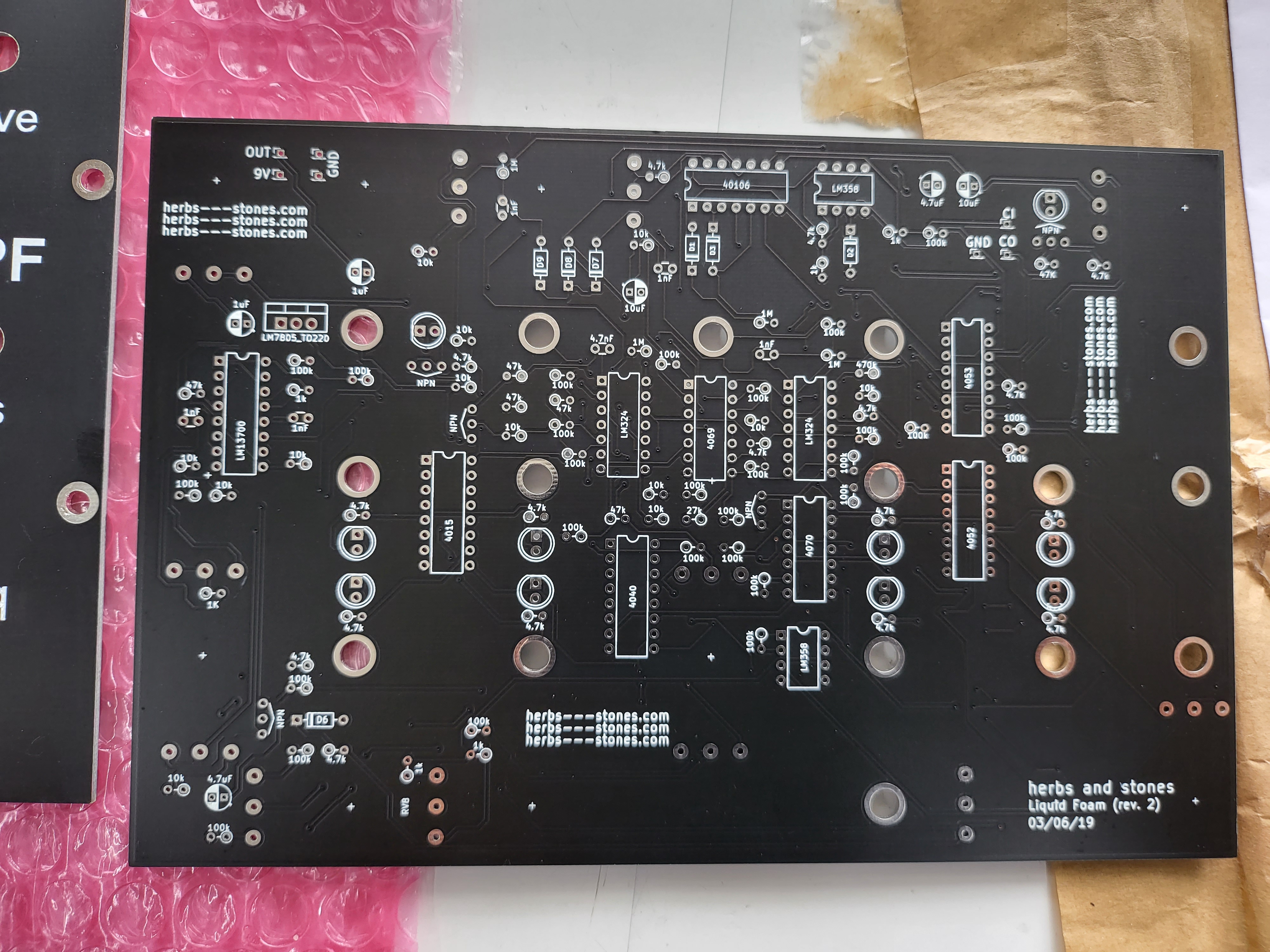
This is a quirky groove box.
Very acid sounding -- like a TB 303
Here’s a pdf of the official manual.

Mine was built from a kit ... just the PCB and panel were supplied.
All parts were easy to find.
The synth is a easy and cheap way to enter the world of Banana Synths.
If you have a Serge system, this is a perfect addition.
The important thing to remember is that any jack with a circle around it is an input.
All other jacks are outputs.
I'm powering mine from a old 6V adapter, so I like to keep any voltages that I'm inputting
from external synths in that range... 5V is safe.
The Liquid Foam is monophonic.
Its made up of 2 sequencers, a DAC, an analog VCO, one 2 pole 12dB/oct LP filter, one EG,
a CMOS based overdrive and a wave mixer/shaper.
The sequencers
It has two square shaped sequencers ... left and right .
They are unusual in that you can't see any of the usual note info, etc that you would normally
see with a sequencer.
Both are linked to the master clock ( but they are slightly differently from each other).
The 8 jacks in these sequencers are outputs.
(It's ok to stack outputs)
 ...
...The Left sequencer
The left one rotates in a clock wise direction.
It's controlled by the main clock.
The right is influenced by the LFO & the clock.
It seems to bounce up and down
Note that both sequencers output gates .... on/off 5V pulses.
They don't output any specific pitch info.

They change the rotational direction of this sequencer.
The X/Y jacks are only inputs.
If we start to stack cables into these inputs you will see
the usual clockwise direction of this sequencer
start to change
The right sequencer & LFO

The right sequencer is linked to the LFO (and clock)
It's a rectangle wave LFO.
You can change its width & rate
So you can set how long the pulse width is.
By tweaking the LFO rate & width you can send the
sequencer into a counter clockwise direction.
Use this sequencer to add randomness and stop
your patterns going stale. I like to plug these outputs
into the X/Y inputs for the right sequencer
So if these sequencers are only outputting 5V gates how does the synth produce CVs for pitch?
The answer lies with a DAC ... a digital to analog converter.
The DAC (and VCO Pitch)

A, B & C inputs are connected to a (3-bit ??) DAC which converts any 5V gates into
control voltages for pitch. I think these CVs must pass through a quantiser before
reaching the pitch input of the VCO.
There is a max of 7 different pitches which can be created.
The pitch you will finally hear depends on the gate combination.
The combination (from low to high pitch) are:
A, B, AB, C, AC, BC, ABC,
The simple combination of gates converted into CVs with a basic DAC produces really
interesting patterns which I don't think would be easy to replicate with a standard sequencer.
The Envelope Generator

I addition to the LFO, the liquid Foam has a single
envelope generator.
The envelope is triggered every time a gate is received
at inputs A, B or C.
It's primary route is to the filter cut-off frequency
I like to use this as kind of an accent.
Note that the EG doesn't have an attack. Its decay only, but there is an offset.
The decay will control the length of the envelope.
The envelope has two inputs.
The upper input will invert the envelope. (that influences the filter cutoff)
The invert knob will then set how much that inverted signal will effect the filter.
This means that the same sequence can have different envelope slopes on different steps.
However, if you connect a gate onto the "eg->VCO", the EG will now influence the VCO pitch.
This will also bypass any gates received at inputs A,B or C.
When combined with an inverted envelope, this can be used to produce glides between notes.

There are two sets of wave mixers with two knobs
for the upper & lower mixers.
The mixer combines triangle / saw & rectangle
waves with variable pulsewidth.
The top knob controls the shape of the waveform.
Extreme anti-clock (left)= triangle
Extreme right = saw
In between = will combine both waves
The lower knob works really well if the upper knob is in the triangle stage (extreme left).
But it mixes whatever is in the top stage (tri/saw or their combination) with a rectangle wave
Playing around with these two knobs give a really interesting transition between different waves.