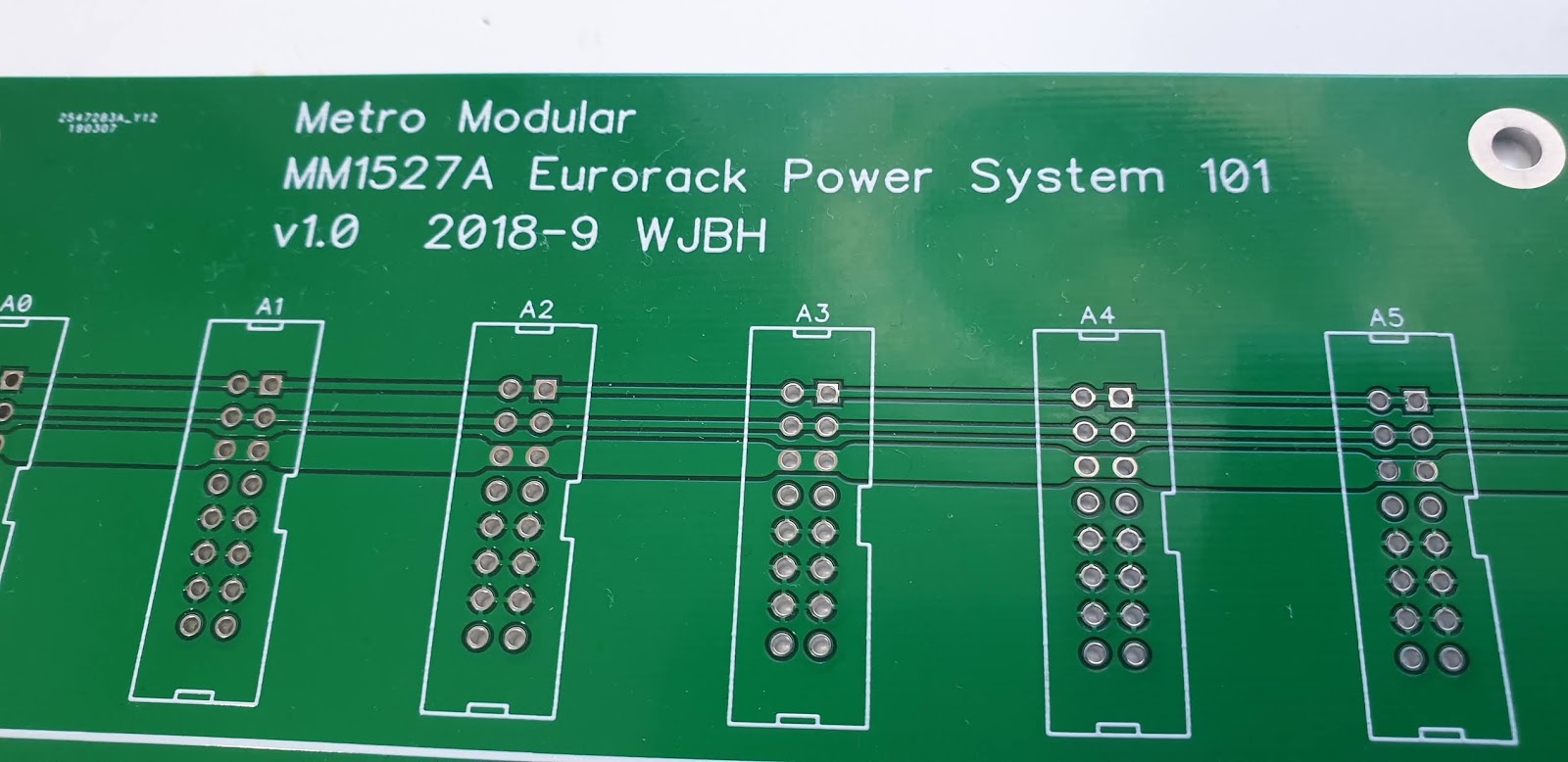
When soldering these components, I found that some needed more heat than I usually use on my soldering iron. My standard temperature is 300 degrees celsius.
My guess was that the ground was acting like a heat sink.
I consulted Justin about this and he confirmed that he used planes on all the rails except the 5V .
In addition, he used 2 oz copper which doubles the thermal conductivity.
So when building one of these boards, it's probably a good idea to use temperature controlled irons.
Keep the temp around 350 to 400 degrees, but drop the temp when soldering temperature sensitive components like capacitors.
The PSU is designed to use a DC brick 17V to 20V DC
These are commonly used in laptop PSUs
I had a chance to catch up with Justin of Metro Modular on the weekend.
He explained to me a bit about the 660 module.
There are two inputs at the base ... the Banana is CV. Tiny is audio.
At the top of the module we have the outs -- also audio & CV ( The red bananas are gate outs).
In the centre we have the wheel composed of 32 LEDs.... 8 in each quarter.
The theory is that if you put in two audio sine waves that are 90 degrees apart, like say the individual pole outs on a self oscillating VCF the MM660 will generate square waves at 1x, 2x, 4x, 8x, 16x, and 32x the frequency.
These are available as gate & audio outs.
They are also summed to give a arp like effect (similar to the korg Poly-61 like sawtooth/staircase ARP).
You of course don't need to use just sine waves inputs and both inputs don't need to be in phase with each other. This is where things get interesting.
I did a quick patch using a 281r,292r, 266r, a wogglebug and a CV processor.
I didn't have an audio source so we just used the CV inputs. This was interesting as the 660 became a sound generator.
I've fed the audio outs of the 660 into the 292r - low pass gate.
I'm just using the 292r as a VC mixer
So in this patch the only sounds are from the MM660.
There is no other audio source like a VCO. The MM660's LEDs are triggered using the outputs
of two channels of the 281r function generator which are in self cycling mode. I'm just playing with the 281's envelope's attack & decay.
The wogglebug and 266r are providing CVs to simply open and close the 292 VCAs
The spinning of the LEDs indicates the relationship between the two CV inputs.
Changes in their phase or shape will move the LEDs.
At LFO speed, very little audio is generated, but at higher rates we have sound.
......................
What does Greek Philosophy have in common with the Sex Pistols and modular synthesizers?
At first glance, not a lot..... but delving into the MetroModular Boethian Wheel module it's worth considering this and the "Wheel of Fortune & of Fate"
The module takes it's name from the Roman/Greek Philosopher, Boethius (c. AD 475-525) who lived under the rule of the Ostrogothic Emperor Theodoric. Though most people won't have heard of Boethius, it was through him that translations of Aristotle survived. This alone should be enough to cement his name in history, however he is mainly remembered for one book.
His life began full of luxury and prestige. Boethius held high public office, but his life suffered a sudden reversal of fortune. He was imprisoned for the crime of treason (which he didn't commit). While awaiting the trial he wrote this book: The Consolation of Philosophy.
The book explores how evil can exist in a world with God. We today, often ask ourselves how can bad things happen to good people if there is a God? Though this link to Christianity is implied in the book, no reference to Jesus or the Church is made. Boethius doesn't ask God why this bad luck has befallen him. Instead, the book is a conversation between himself and "Lady Philosophy". They discuss the fleeting nature of wealth and fame ("no man can ever truly be secure until he has been forsaken by Fortune").
She teaches that happiness comes from within, and that virtue is all that one truly has.
On human nature, Boethius says that humans are essentially good and
only when they give in to “wickedness” do they “sink to the level of
being an animal.”
It's a really interesting book, written by a Christian who was also a Platonist. His morality and ethics lie within the Greek/Stoic tradition. I think this may be one of the very first "self help" books... and the fact that it was written in one year (AD 523) by a man in prison makes it all the more compelling a read.
And so what do the sex pistols have to do with Boethius?
The Sex Pistols , Joy Division, New Order , etc appear in the 2002 movie
"24 Hr People"
It's basically about Factory Records.
There is a famous quote about the Wheel of Fortune from the movie:
These are unofficial build pics and notes for the Metro Modular phase shifter.
Please check this with the official notes when they come out.
There are two inputs.
Each takes one audio signal (above 1.7Hz) and outputs two signals that are out of phase with one another.
You could use it in conjunction with a ring modulator to get some frequency shifting.
A quadrature signal would also be useful for driving the Boethian Wheel - Model 660
The module is in 4U Buchla format.
I'll be updating this as I proceed with the build.
The MM2196 goes by the name "Roselands" which is a Sydney suburb with the same postcode.
There are 2 identical PCBs for each module. So you need to double the BOM
The BOM for each board is: (Please check this with the official notes when they come out.)
Resistors:
10R x 1
100R x2
220R x 2
680R x 2
1.5k x 2
3.57K x 18
10k x 2
15k x 1
22k x 4
68K x 1
82K x 1
100K x4
150K x 2
25K trimmers x 4
Capacitors
220pf - ceramic x 1
470pf - ceramic x 2
4n7 - polyester x 2
47n - polyester x 2
470n - polyester x 2
100uF - electro 16V x4
1uF - electro 16v x 1
Ps where it says 3k57 for the resistors, 3k6 are fine. Stick with 1% for resistors on most things in this build.
470pf and 220pf are ok as C0G (single layer ceramic) or NP0 (ultrastable or temperature compensating capacitor) ceramics, make the others polyester. The electros can be 16V
These are the trimpots I'm using.
Standard Buchla connector to the front-Only need the +15 and Q lines.
The transistors that I'm using are: bc560
bc550
Way
to assemble is to put one board (with power connector) on, screw it in
place between the spacers, wire it up and calibrate. The three pins
(SV1) behind the power connector can be used for a 3-pin header
pin/socket pair that you then solder onto the next board stacked above.
Screw it in, wire it up and calibrate. You’re done.
Calibration frequencies. (Left to right) use 10hz, 100hz, 1khz and 10khz sine waves.