Sunday, 3 December 2017

Vactrols - Optocoupliers

 Vactrols and Optocoupliers 
 
Vactrols are sometimes called Opto-isolators, photocouplers and optical isolators.
They all use a similar idea, though this post is mainly about vactrols.

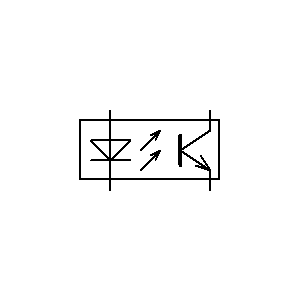
One side has a a light source of some sort
This could be a LED (or an incandescent bulb).
The other side uses something which is photo sensitive.
This could be a LDR (Light dependent resistor) or a  photosensitive transistor.
Applying a voltage to the LED causes it to light up. The light falls on the LDR.
The intensity of the LED directly controls the photo-transistor / LDR.

Thus this resistor becomes voltage controllable.
 
 
This is a Doepfer LPG... based on a Buchla 292 module.
It uses vactrols.

Through the use of a vactrol, anything which is normally controlled by a potentiometer or variable resistor can become a voltage-controlled parameter. Applying a voltage to the vactrol's LED is just like turning the knob on the potentiometer.
 
In addition, since the LED and LDR can be controlled by different circuits we are thus electrically isolating the two different circuits.
Thus, vactrols are sometimes called opto-isolators.

The hollowed space between the LED and photo-transistor/resistor can be made using glass, air, or a transparent plastic.
 
The resistance of the LDR doesn't change instantly.
It takes time ... the change is not linear either.
"It may take a few seconds until the LDR reaches it's dark resistance (i.e. the maximum resistance without illumination)" Doepfer.
 
A brief History
In 1967 Vactec introduced a compact RO (resistive optocouplier) branded as Vactrol. Unlike the tube-coupled ROs of Fender and Gibson, Vactrols were sealed and sturdy devices. They originally used incandescent bulbs. In the early 1970s, Vactec replaced the incandescent bulbs with LEDs. This increased the switching speed and probably also their reliability.

In 1983, Vactec was purchased by Perkins-Elmer. Their vactrol division was spun out from the company and changed their name to Excelitas in 2010.

In the European Union, the production and distribution of Cd-based photoresistors was banned after January 1, 2010. This decision marked the beginning of the end of Excelitas vactrols. However, CoolAudio started manufacturing the VTL5C3 and Xvive is manufacturing the complete range.
 
Commercial vactrols usually contain LEDs that usually produce infrared light.
The detector is a semiconductor-based photoresistor made of cadmium selenide (CdSe) or cadmium sulfide (CdS). 
Resistive opto-isolators are the slowest type of opto-isolator .
Switching times usually exceed 1 ms, and for the lamp-based models can reach hundreds of milliseconds.
Cadmium-based photoresistors exhibit a "memory effect": their resistance depends on the illumination history; it also drifts during the illumination and stabilizes within hours.
 

 -----
Since it's getting more difficult to find vactrols, making your own may one day be the only option.
 
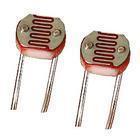
These are the light dependent resistors which I  like to use.
GL5549
The type of LDR is impt.
It should have a dark resistance of at least 0.5M ohm.
I like a slow attack (or response time). 
VTL5C3s have a slope of 20, a dark resistance of 10M Ohms and a very slow response time.

  LDR type nr 5516.are good too.
 The 5516  specs say  it gives about 5 to 10 kOhms at full brightness 
 
 
Suggested LEDs are red/green/orange/yellow.
 

The colour of the LED will have a bearing on how the vactrol works.
So experimentation is in order.
 
This is an example of a DIY vactrol.
Its part of a Eurorack module:
The NonlinearCircuits Dual LPG 
 
 
I read somewhere, that yellow LEDs make the most efficient circuit.
The best match is I think between green and green/yellow.  A blue LED is probably the worst possible choice.
Also remember that LED colours are normally not standard or very precise from one manufacturer to another.
 
 Here is another example of a DIY vactrol.
I used black shrink wrap. 
 
 
To get the best possible performance, the LED and LDR should have equal wavelengths.
This will require checking datasheets to find a good match.  
 

Model

-

 Size   (mm)

Light resistance(ohm)

Darkness resistance(ohm)

Max voltage (DC): 

Max power consumption

Operating temperature

GL5506

-

5X2

2K~5K

0.2M

150V

100mw

-30C° ~+ 70C°

GL5516

-

5X2

5K~10K

0.5M

150V

100mw

-30C° ~+ 70C°

GL5528

-

5X2

10K~20K

1M

150V

100mw

-30C° ~+ 70C°

GL5537-1

-

5X2

20K~30K

2M

150V

100mw

-30C° ~+ 70C°

GL5537-2

-

5X2

30K~50K

2M

150V

100mw

-30C° ~+ 70C°

GL5539

-

5X2

50K~100K

5M

150V

100mw

-30C° ~+ 70C°

GL5549

-

5X2

100K~200K

10M

150V

100mw

-30C° ~+ 70C°


 A bit about the Buchla 292 LPG
The 292 Quad Lopass Gate is very famous for its use of vactrols, 
The LPG is kind of a VCA
You will find that the minimum release time associated with a vactrol is a lot longer than that of the typical (non-Vactrol) VCA, 
It is thus impossible to produce snappy drum sounds using a 292
The drum sounds tend to ring for about 30 ms after triggering 
This occurs even if the 281 envelope generator that is controlling the LPG is set for 
its minimum value.

------
There are a few commercial vactrols you may come upon.
 This is a NSL type vactrol

The single vactrol NSL. the white dot marks the cathode.


Below are some Perkins-Elmer/Excelitas VTL 5C3/2
VTL 5c3/2..... I used them a lot in the buchla "clones"..
These are getting really hard to find.
 
 You may come across these Xvive versions.
I understand they are made in China

The manufacturer says they are a modern clone of the old Perkins-Elmer VTL53C
 
These are I understand also Xvive vactrols


Saturday, 2 December 2017

DIY index

This is the index for all DIY projects.
General Electronics
+ LCD display i2c - part 1  
+ LFOs - making simple LFOs using a CD 40106 IC
+ Microcontroller... What you need to program a MCU 
+ Microcontrollers... Programmers
+ Sequencer CD 4017 
 + Simple oscillators & LFOs using a CD 40106 IC
+ OTAs - operational transconductance amplifiers
+ Panel, making using gerber files
+ Switches - Momentary push buttons & Pull down resistors   
+ TKB - Serge Build notes (Human Comparator)

----------------------------------------------------------------------------

+ 3 Trins Video synth
+ The Ship of Thesus
+ Adding anchor links in Google blog

ARP 2600 - TTSH

Balanced vs Unbalanced Audio

Buchla
 
Cat Full Of Ghosts


Ciat Lonbarde
 + Gerassic Organ

CMOS
+ Sequencer CD 4017 
+ Simple oscillators & LFOs using a CD 40106 IC

Eurorack

 + Adding +5V  to your Bus.
 + Distribution  - power bus

Elmyra Synth 
   + Build notes


Fates 
+ Fates - a DIY Norms for Rasberry Pi

 Influential ICs

Jasper - Wasp
+ Build notes for the jasper - Part 1
+ Jasper build notes - Part 2
+ Midi interface

Lorre Mill
  + U Tone

LZX - Cadet
 + Cadet I - Video Sync Generator - Build notes
 + Cadet II - RGB Encoder - Build notes
 + Cadet III - Video input - build notes
 + Cadet IV - Dual Ramp generator - build notes
 + Cadet V - Scaler - build notes
 + Cadet VI - Fader - Build notes
 + Cadet VII - Processor -Build notes
 + Cadet VIII - Hard Key Generator - build notes
 + Cadet IX - VCO - build notes
 + Cadet X - Multiplier - Build notes

LZX - Castle
Introduction
00_000 ADC - Analog to digital converter
01_001 DAC - Digital to Analog converter
02_010 Clock VCO
03_011 Shift Register
04_100 Multi Gate
05_101 Quad Gate
06_110 Counter
07_111 Flip flops


Microcontrollers
+ Microcontroller Index Page

NLC
+  Full list of (NLC) NonlinearCircuits projects

PSU  juice for your synths
 + NLC large board - build notes
 + NLC small board - build notes  
 + BOSS ACA vs PSA Psu (Power supplies)


+ Resistor Arrays
+ Serge - CGS - Buchla

+ Shopping for components
+ Soma - Lyra 8 build
+ Synth Lab (SDIY)
+ Synthacon - Steiner-parker

Python
+ Python for beginners 1
+ Python for Beginners 2

Soma Lab
 + Lyra 8 build - part 1 
 + Lyra 8 Part 2
 + Lyra 8 Part 3 is here
 + Making the Lyra Panel face plate
 

Thermin
+ Thermin - Silicon Chip general info

Vidiffektor - build notes

Wirehead Freaq FM

Wasp - Jasper
+ Build notes for the jasper - Part 1
+ Jasper build notes - Part 2

-----------------
+List of integrated circuit dimensions
+Surface Mount Nomenclature & Packaging.
+SOT (Small Outline Transistor dimensions)
+Voltage divider, LED resistor calculator 
+SMD / SMT resistor code
+Desoldering tips - Belltone 


 "The man that hath no music in himself,
Nor is not mov'd with concord of sweet sounds,
Is fit for treasons, stratagems, and spoils."
- The Merchant of Venice (V, i, 83-85)


Modular On The Lounge

The first MOTL (Modular On The Lounge) .... held at a secret location in Wollongong, NSW, Australia.

All my synth friends were dying for a chance to get together, chat about synths, and get some performance practice.
 So we found a living room and couched it for the night.

 A great turnout.
 
 We set up a projector and a Video Synth.

Justin from Metro Modular showed us some of his new modules.

This modular just arrived back from Japan.


The MM339A Gainriding VCF
I'm especially looking forward to this filter as it's original designer was Dennis Colins who had a hand in designing the ARP 1047 filter (for the ARP system 2500).

MM6031B Marshall LPF Explorer Edition


Hopefully there will be more of these nights in the future.

A post shared by jono (@dj_jondent) on

 #cobramatic

A post shared by jono (@dj_jondent) on

Thursday, 30 November 2017

CellF Action - Build notes

Finally getting around to this.
Andrew put these out in 2015 (along with the CellF Voice).
Andrew's build notes are here:
http://www.sdiy.org/pinky/data/cellF%20action%20BOM%20&%20build.pdf

A big-ish build I think.

Some closeups of the PCB to help with later troubleshooting.
Right of PCB

Centre PCB

Left PCB

The Action panel uses three NJM13700
https://www.njr.com/semicon/PDF/NJM13600_NJM13700_E.pdf
They are current controlled transconductance amplifiers.
I'm using the same components I used on the cluster build


ICs:
I'm using sizes SOIC-14/16, SOP-16
SOIC = Small Outline IC
SOP = Small Outline Package 

"A Small Outline Integrated Circuit (SOIC) is a surface-mounted integrated circuit (IC) package which occupies an area about 30 to 50 % less than an equivalent dual in-line package (DIP), with a typical thickness that is 70 % less. They are generally available in the same pin-outs as their counterpart DIP ICs. The convention for naming the package is SOIC or SO followed by the number of pins. For example, a 14-pin 4011 would be housed in an SOIC-14 or SO-14 package."
(Wikipedia)
 There are 5 fixes needed to the slew of the logic module.
 

 I added the 47K resistor to the underside of the PCB

gETTING there. Just waiting on some components from Mouser.
This is a big build.
ICs and most of the SMD passives are in.


-----------------------------------------------

Having trouble sourcing the TLP291-4 - quad opto-coupler package. ?? Mouser no
I'm trying these:
https://au.rs-online.com/web/p/optocouplers/6936807/

-------------------------
LED resistors.
I'm using 1.5K resistors for the RL components.
Andrew's build notes for the Cell F Voice panel said:
For regular LEDs use RL = 330Ω-470Ω
forultra/superbrights use RL = 4k7Ω-10kΩ

I may have to change this once I get the board up and running.
Easy enough to do with SMD .


Time for the pots and jacks
 Notice the height of the jacks. The switch is taller than usual and this is forcing me to raise the level of the jacks & pots.
 Soldering the pots was a tad tricky. 


You will need 4 of these JFETs


These are the 1K tempcos draped over transistors in QUO and VCO sections


fINAL pics.


Links:
+ NLC Build notes for Cell F Action panel
+ Build notes for Cell F voice

--------------------------------------------------------------------------------------------------- Click here to return to the NLC Build Index: http://djjondent.blogspot.com.au/2015/03/non-linear-circuits-ncl-index.html